


Scripture Songs · Psalm 23
Psalm 23 Song
The shepherd psalm has been sung at bedsides, gravesides, and cradles for three thousand years. Listen to our setting, then paste the psalm in your own translation and hear it sung in the style your moment needs.

5 free songs with every monthly subscription
Hear real examples
Every track below was generated with this tool — press play, then make yours.
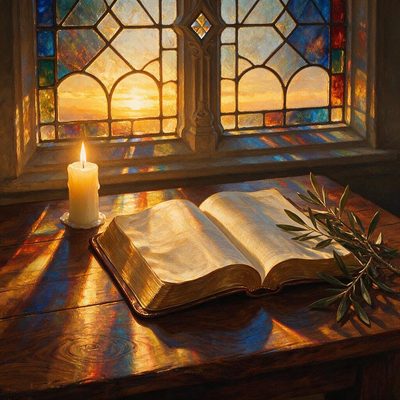
Hear the album
Bible Verse Songs
Fifteen scriptures you already know, sung
"The LORD is my shepherd; I shall not want. He maketh me to lie down in green pastures: he leadeth me beside the still waters. He restoreth my soul." Psalm 23 is the most requested scripture song there is, and it is easy to hear why: six verses that move from pasture to valley to table to home, and never once raise their voice.
People reach for it at the extremes of life — a hospital room, a funeral, a child's first memory verse — because it promises presence rather than explanation. "Thou art with me" is the hinge of the whole psalm, and a melody makes that line stay in the body long after the service ends.
Our finished setting, "The Lord Is My Shepherd," lives in the Bible Verse Songs album. Below you can play it, borrow its prompt, or paste the psalm in your own translation and make a version that sounds like your church, your family, or your grief.
From prompt to sung lyrics
From the album — The Lord Is My Shepherd
Prompt: “Psalm 23 — gentle acoustic worship, fingerpicked guitar, soft piano, light strings, warm female vocal, unhurried and peaceful, 72 BPM”
[Verse]
The Lord is my shepherd, I shall not want
He makes me lie down in green pastures
He leads me beside the still waters
He restores my soul
[Chorus]
I will fear no evil, for You are with me
Word for word, for a memorial
Prompt: “Psalm 23 KJV word for word, solo piano and cello, tender, slow, 64 BPM”
"Yea, though I walk through the valley of the shadow of death,
I will fear no evil: for thou art with me;
thy rod and thy staff they comfort me."
— the exact KJV text, unchanged, on an original melody.
Song ideas to start from
How it works
- 1
Describe your song
Type one sentence — the person, the story, the vibe — or start from an example above. Any language works.
- 2
Pick a style and length
Vocals or instrumental, any genre, from a 15-second hook to a full-length track. Or write every lyric yourself in the studio.
- 3
Generate, download, share
Your song renders in minutes with cover art and its own page. Download the MP3 or just send the link.
What Psalm 23 says, and why it wants to be sung
The psalm is a short walk with a shepherd: green pastures and still waters, a valley of deep shadow, a table set in front of enemies, an overflowing cup, and a house to dwell in forever. Nothing in it argues. It simply describes what it is like to be looked after, which is why it reads as comfort even to people who have never opened a Bible.
It was written as a song, and it behaves like one — a calm opening, a darker middle, a resolution that widens into "all the days of my life." That arc is exactly what a chorus and bridge are built for, so Psalm 23 sets to music with almost no effort. The shepherd imagery also gives a musician everything they need: space, stillness, a slow steady pace.
How to make your own Psalm 23 song
Open the composer, choose Lyrics mode, and paste the psalm in whichever translation you love — KJV for "maketh" and "leadeth," a modern translation for something that sits closer to speech. The words are never altered; the melody is written around them. Then add one line describing the sound: instruments, vocal, mood, tempo.
Style lines that work well here: "gentle acoustic guitar, soft piano, warm female vocal, 72 BPM," "classic hymn, organ and small choir, 66 BPM," "solo piano and cello for a funeral, 64 BPM," or "bright and repetitive for kids memorizing it, 100 BPM." Edit any lyric line before generating if you want a chorus to repeat, then generate.
In one to three minutes you get full vocals and production, cover art, a shareable song page, and an MP3 download. Most people make two versions — one for the service, one quieter for the car ride home.
Styles that fit Psalm 23
The psalm has a native pace, and it is slow. Our album version uses fingerpicked guitar, soft piano, light strings, and a warm female vocal at 72 BPM — unhurried enough for every phrase to land. If you want tradition, ask for a hymn setting with organ and a small choir around 66 BPM; it comes out sounding like something a congregation has always known.
For a memorial, strip it back: solo piano, cello, tender, 62 to 66 BPM. For bedtime, a music-box lullaby with a hushed vocal at 60 BPM turns "I shall not want" into the last thing a child hears. For Sunday school, a bright singalong with hand claps at 96 to 104 BPM makes the six verses memorizable in a week. Gospel piano and choir at 74 BPM gives it warmth without losing its stillness.
Where a Psalm 23 song gets used
Funerals and memorials first — it is the most requested tribute scripture there is, and a sung version gives a grieving family something to hold when readings feel too thin. Hospital rooms and hospice visits are next: a gentle Psalm 23 on a phone speaker is a prayer that does not need anyone to find words.
Then the everyday uses: memory-verse practice for kids and adults (the whole psalm memorizes itself by accident after a week of play), Sunday school openers, small-group nights on the shepherd psalms, and personal devotion. A word-for-word Psalm 23 in your own translation, in your own preferred style, is the kind of song people keep on a playlist for years.
Frequently asked questions
Can it sing Psalm 23 word for word?
Yes. Paste the psalm in your preferred translation into Lyrics mode and it is sung exactly as written — every "maketh" and "leadeth" kept. The melody is composed around the text, and the text is never changed.
Which translation should I use for a Psalm 23 song?
Any you like. KJV sings beautifully and is public domain, which makes it the safest choice for public use at services. Modern translations sit more naturally in contemporary styles. Try both — they are two different songs.
Is the Psalm 23 song free?
Every monthly subscription includes 5 free songs. After that, songs cost 5 credits each. The finished album version is playable on this page and in the Bible Verse Songs album.
Can I use a Psalm 23 song at a funeral?
Yes, and it is one of the most common uses. Ask for something slow and tender — solo piano and cello, 64 BPM — and you will have a full setting with an MP3 download in a few minutes, ready for the service or the slideshow.
Is there a Psalm 23 song for kids?
Make one: ask for "bright, repetitive, singalong, with the reference sung at the end" at around 100 BPM. Kids memorize sung text far faster than spoken text, and Psalm 23 is short enough to learn whole.
Takes about a minute to start. 5 free songs with every subscription.